
Escapist Ruminations: Japan
TL;DR: the puzzle scene in Japan is 🤯

I recently returned from 3 months in Japan, and at risk of hyperbole, this trip was life-changing.
A month in, I shared my initial thoughts here on Substack. Already, I’d played some wonderful games and seen many beautiful sights, but I truly had no idea how much was yet ahead of me.
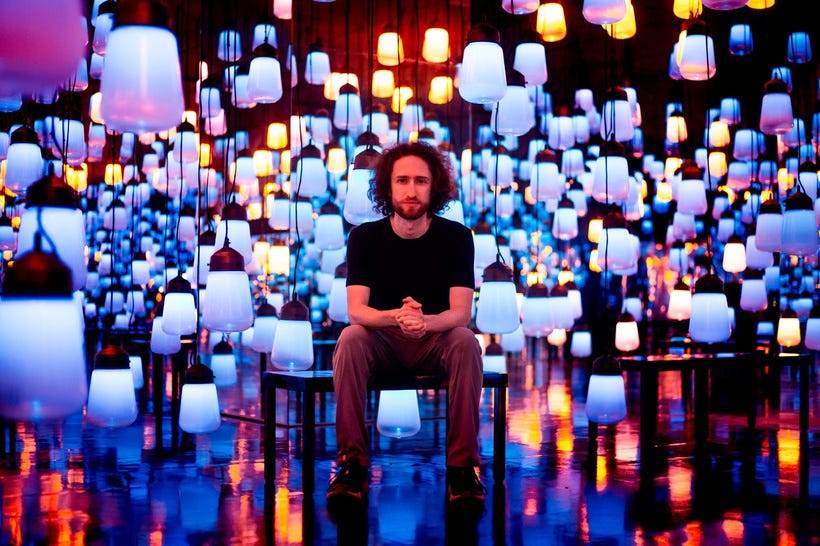
At the Nazotoki Market, I met a number of brilliant Japanese puzzle designers who graciously welcomed me into their worlds and served as my guides in playing numerous puzzle games available only in Japanese. Many of the experiences translated into English were great... but some of the Japanese-language games featured seriously next-level puzzle design. And, even for the experiences with English versions, often the original Japanese versions contained more puzzles or more elaborate puzzles, with heavily language-dependent gameplay getting cut rather than meaningfully adapted.
In total, I played around 60 experiences: a mix of escape rooms, hall games, metro and walking hunts, facility tours, cafe games, and puzzle boxes. I also brought back 100+ at-home games, representing a wide range of styles and formats.
I have so many thoughts buzzing around my brain, and now that I’m home, I finally have time to write more about all of it.
But first, the question I’ve been hearing most frequently is: “I’m going to Japan soon. What should I play/see/do?” So, without further ado, here are my puzzle and immersive recs for English speakers visiting Japan!
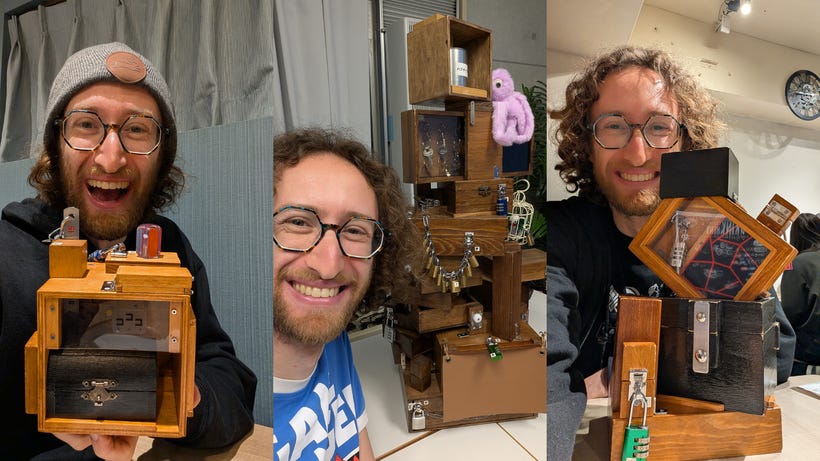
Super Secret Japanese Rec Guide
Before arriving in Japan, I’d only really heard of one Japanese escape room company: SCRAP, aka Real Escape Game. SCRAP is arguably the world’s first IRL escape room company, opening their first game in 2007, and they’re still by far the largest company in Japan. However, in contrast to other international markets where most bigger escape room chains tend to have low-quality games, SCRAP has maintained a high level of quality and innovation, and they remain well-respected amongst Japanese puzzlers.
SCRAP officially offers certain games in English at 3 of their Tokyo locations, and I played everything available as of December 2025.
My favorites were:
A Challenge from the Crafting Genius (Real Escape Game Crossing Asakusa): Utterly genius take on a hall game, with some of the best designed tactile puzzling I’ve encountered anywhere. It’s not a traditional escape room, but it’s also far from solving paper-and-pencil puzzles at table... speaking of which, where even is the table?! Gotta get crafting!
We played with 2, and it was difficult to physically do everything in time, so I recommend playing with 3-4 players.
Escape from the Runaway Train (Tokyo Mystery Circus): This might be a polarizing one, but we adored it. SCRAP’s “Nine Rooms” format is a set of 9 pipelined mini escape rooms, culminating in a difficult yet remarkably elegant final room.
I’ve heard from other international players who’ve had less love for this format, and for this game in particular... so I have some advice. We actually failed the first time, took a few minutes to think through the scenario and had some big breakthroughs, then purchased a “revenge ticket” to replay that final room and succeeded with time to spare. Think through everything you’ve seen, what specific questions are being presented through the narrative, and what information you might be able to reuse in a new way. Nothing is random or illogical.
This style requires much more insight and inspiration than most Western escape rooms, but it’s also infinitely more satisfying when you ultimately get it because you’ve really earned it.
Escape from the Blue Room (Real Escape Game Ikebukuro): Brilliant layered puzzles with some of the most impressively designed reveals I’ve encountered anywhere. Very challenging, very satisfying.
This is the spiritual successor to The Red Room, which is old but iconic and also worth playing. Both “color series” rooms are designed to require no language, but unfortunately the Ikebukuro location doesn’t have English support yet, so the Blue Room isn’t officially available in English.
Escape from the Never-Ending Locks and Keys, also at the Ikebukuro location, presents a cute spin on searching and used to be offered in English, but the same note about official language support applies. During my visit, the staff spoke no English but actually had English versions of the in-game clues available for us.
SCRAP also offers a number of walking hunts, of which the Asakusa and Yokohama hunts have English versions. I enjoyed both as nice, lightly puzzly explorations of an interesting neighborhood, with puzzle complexity picking up a bit in the final segments. Yokohama had some especially cool papercrafting bits... but unfortunately, that part was cut from the English version of the game. (I bought both versions to compare, and I was able to struggle through the Japanese on my own with online translation tools, as I did for many other puzzle games that required elementary-level Japanese.)
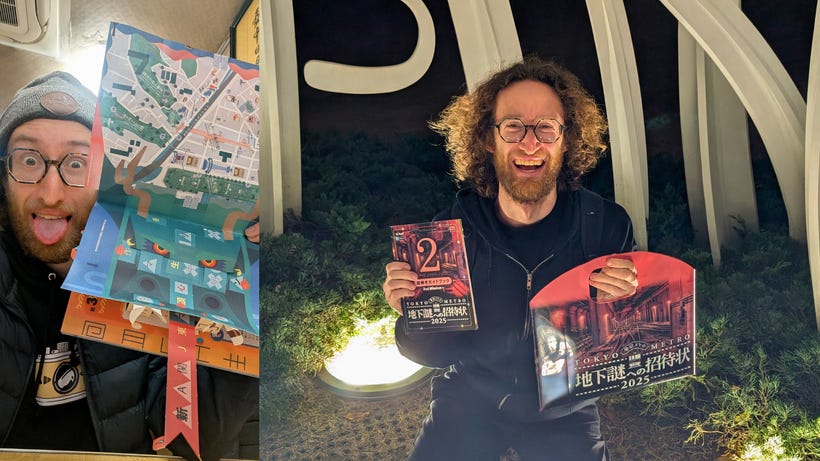
By far my favorite walking hunt was SCRAP’s 2025 Tokyo Metro Hunt (running through March 31, 2026)... which is also only in Japanese this year, though they’ve offered an English version in the past. It had such a brilliantly layered puzzle sequence and epic 3D reveals from flat components that I’m still giddy about weeks later. If you can find a way to play it, I very highly recommend.
The other big player for English-friendly games in Japan is Studio Escape in Osaka. Run by British expats, all 4 of their games are fully available in English, and they’re all fantastic. Shadow Zen is the most commonly talked about, though I personally thought Madame LeClaire ties for their top game, and I think each of their games will be someone’s favorite. To note: these are very much Western style, more narrative and experiential games with light puzzles, quite different from the Japanese style. They’re best experienced with 2-3 players.
Back to Tokyo, SCRAP is far from the only noteworthy company. Tumbleweed and Yodaka had my favorite puzzle styles, though just about all their events are only in Japanese. If you stop by Tumbleweed’s shop in Shimokitazawa, pick up a copy of the Fantastic Flag Puzzles book, which has an English version and is a great representation of the Japanese style.
Escape cafes are also increasingly popular in Japan, and I especially frequented Nanica in Shimokitazawa. It’s a delightful venue concept - sort of an art gallery speakeasy where you walk through a picture frame secret door to enter. None of their cafe games are in English, but they also have no time limit, you can use your phone for translation, and most of them use the LINE app with built-in hints. Their hall games are also quite fun, but you’d need to go with teammates who are fluent in Japanese. However, they actually had one surprise option...
Strange Box: Nanica’s room-style game is fully language independent! This 30-minute game had clever tactile puzzling with an elegant structure and fun gimmicks. I was surprised to find that not only did it not require language... a few of the puzzle answers were actually basic English words! That said, Nanica as a venue does not support English, so please be respectful of the staff if you try to play this.
Another escape cafe in Osaka called TokiToki falls into a similar category. The venue itself is not guaranteed to have any English-speaking staff, and their escape rooms are only in Japanese, but they have multiple puzzle boxes that require essentially no language. As of my visit, they had 4 boxes by Kaerimichi Kobo that didn’t use language, with only rule and story pages in Japanese which were easily translatable with Google Lens. These boxes are:
The First Demon King’s Box and the Best Magic Dispeller
メッキュー (Meckyu)
ロッキュー (Rocky)
ガネーシャ箱 (Ganesha Box)

Outside of escape rooms and puzzle events, I also attended a number of immersive experiences around Japan.
My favorite was Anemoia, an immersive dance piece in Tokyo that uses zero language throughout. It presented a visually striking blend of contemporary and traditional Japanese dance styles. I was quite emotional by the end... it’s these sorts of works that remind me why I fell in love with immersive in the first place.
I also saw 4 shows at Immersive Fort Tokyo, which sadly just announced they’ll be closing permanently in February 2026. If you can get there before then, my favorite piece was Tokyo Revengers Immersive Escape, which combined immersive theater and dynamic fight scenes with some light escape room-y puzzling. The dialogue wasn’t translated, but we found it easy to follow along just from the highly visual, manga-style acting. Puzzles were presented on a tablet per group, and there was an English mode. We also enjoyed The Sherlock, which offered English support for this Sleep No More-esque sprawling promenade immersive show. It was a very Japanese take on Sherlock Holmes, with more supernatural elements than I’d expect for the subject matter, but it was well done.
Last but not least, I visited 6 teamLab locations around Japan: Planets and Borderless in Tokyo, and locations in Osaka, Kyoto, Fukuoka, and Takeo. I’ll share more in-depth thoughts in a future Room Escape Artist piece, but overall: I loved the blend of art, nature, and technology, and even seeing some of the same installations multiple times, they didn’t get old. If you have to pick one, I’d recommend Kyoto. It’s their newest and largest location, and it’s a well curated highlight reel of their best work to date. My personal favorite location, though, was in Takeo at the Mifuneyama Rakuen Hotel. Rather than recreating nature indoors, it takes place in the woods at night, transforming a mountainous trail system into something strikingly otherworldly.
Let me know what you think if you visit any of these experiences, and please share with anyone else who might find this guide useful.
This is just the beginning of my coverage of Japanese puzzle culture. In the coming months, I’ll be writing articles about ō-nazo (“final puzzles” which are a unique style of Japanese metapuzzle), meaningful failure, multisolvability (where puzzles can be solved multiple times to different answers), alternative puzzle business models, and much more.
Happy New Year, and happy puzzling!
Matthew
Note: a version of this post was previously shared to my now-defunct Patreon.